Original source: http://www.bbc.co.uk/sport/rugby-union/57107926
Saturday, 15 May 2021
Alex Goode: Saracens and England full-back returns from loan for Championship run in
Saracens welcome back full-back Alex Goode from his season-long loan at NEC Green Rockets in Japan.

Coach’s Corner Issue 12: Can Taniela Tupou keep it straight for Super Rugby Trans-Tasman?
Statistically, who are the most effective loose forwards in Super Rugby AU and Super Rugby Aotearoa?
– KiwiHaydn
How does Fraser McReight go about his business and what roles does he fulfil in the reds attack and defence?
– Numpty
Everyone rates the work rate of carries and tackles etc of McReight, how does he compare to Hooper last year in this regard?– PeterK
With the new Antipodean crossover competition kicking off this weekend, it is the right time to return to this question, which originally spanned the back-rows on both sides of the Tasman.
The following table includes the top All Black candidates from Super Rugby Aotearoa in 2021, plus the likeliest Wallaby counterparts in each position. Michael Hooper’s 2020 Super Rugby AU stats are also added as a point of comparison. First, on attack:
| Min played | Mins between carries | Gainline +/- | Defenders beaten/offloads | Decisive outcomes (breaks/assists) | Lineouts won/stolen | |
|---|---|---|---|---|---|---|
| Akira Ioane | 437 | 7.3 | 11 | 22/5 | 8 | 4 |
| Luke Jacobsen | 565 | 9.6 | 12 | 8/8 | 6 | 11+2 |
| Shannon Frizell | 593 | 6.2 | 16 | 22/12 | 9 | 22 |
| Rob Valetini | 790 | 9.5 | 19 | 17/4 | 7 | 3 |
| Ardie Savea | 439 | 8.4 | 14 | 16/5 | 8 | 1 |
| Dalton Papalii | 422 | 16.9 | 7 | 6/5 | 6 | 2+1 |
| Du’Plessis Kirifi | 469 | 13 | 4 | 5/0 | 4 | 1 |
| Sam Cane | 291 | 14.6 | 1 | 3/2 | 2 | 2 |
| Fraser McReight | 707 | 9.9 | 19 | 12/5 | 15 | 0 |
| Michael Hooper* | 616 | 8.2 | 11 | 5/7 | 4 | 1+1 |
| Hoskins Sotutu | 600 | 6.5 | 18 | 15/9 | 11 | 19 |
| Harry Wilson | 556 | 7.3 | 1 | 4/4 | 5 | 6 |
*2020 statistics
Some fascinating pointers to the different back-row expectations in Australia and New Zealand emerge from this table.
Australian number sevens like Fraser McReight and Michael Hooper are expected to contribute far more as ball-carriers than their Kiwi counterparts.
New Zealand number sixes and eights do the bulk of the ball-carrying and lineout winning, with the figures posted by Hoskins Sotutu, Akira Ioane and Shannon Frizell throwing Harry Wilson’s becalmed season into sharper relief.
Rob Valetini’s numbers hold up well in the comparison – there may be a case for shifting him to number eight in 2021 for the Wallabies.
Ardie Savea remains an enigma, the ball-carrying impact of a number six or eight built into the athletic body of a number seven.
Now, the figures on defence:
| Mins played | Mins between tackles | Tackle completion | Passive tackles | Turnover/discipline in contact | |
|---|---|---|---|---|---|
| Akira Ioane | 437 | 10.7 | 91% | -5 | -7 |
| Luke Jacobsen | 565 | 10.7 | 88% | -12 | -1 |
| Shannon Frizell | 593 | 8.8 | 88% | -9 | -10 |
| Rob Valetini | 790 | 7.9 | 93% | -9 | -5 |
| Ardie Savea | 439 | 12.5 | 80% | -6 | 2 |
| Dalton Papalii | 422 | 5.6 | 95% | -9 | 1 |
| Du’Plessis Kirifi | 469 | 4.9 | 89% | -11 | -7 |
| Sam Cane | 291 | 4.8 | 94% | -1 | 0 |
| Fraser McReight | 707 | 6.4 | 95% | -7 | -4 |
| Michael Hooper* | 616 | 6.1 | 90% | -16 | -3 |
| Hoskins Sotutu | 600 | 14 | 90% | -15 | -5 |
| Harry Wilson | 556 | 6.8 | 89% | -13 | -9 |
*2020 statistics
New Zealand number sevens are far more active on defence than their sixes and eights with extremely high work rates – averaging one tackle every five minutes. This may represent the more varied range of attack in New Zealand, with the ball moved wider more often.
The selection emphasis for a number six or eight in New Zealand lands squarely on ball-carrying and lineout ability – a perception backed up by Dave Rennie’s initial picks for the Wallabies in 2020. In Australia, there is more emphasis on all-rounders who can contribute in attack and defence, but less at the set-piece.
The premier opensides all show excellent discipline in contact, with takeaways balancing the number of balls given up and penalties conceded in the tackle.
The contest between Fraser McReight and the Kiwi opensides promises to be one for the connoisseur, and there is every reason to believe the young Queenslander will emerge from the competition with his reputation enhanced.
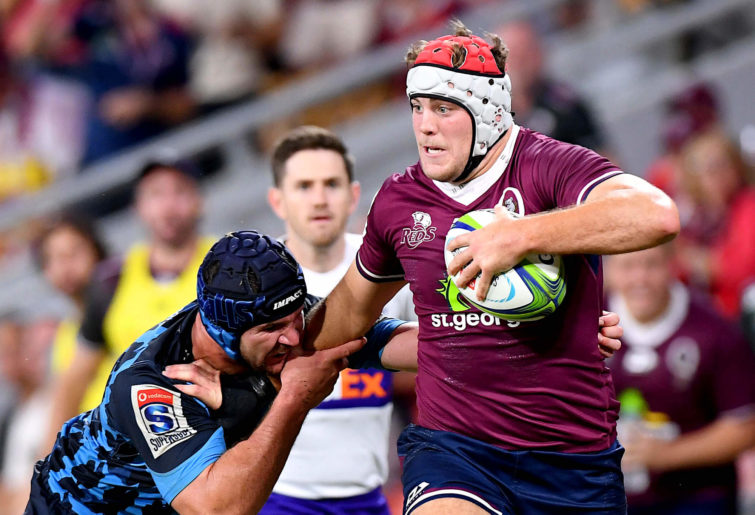
Fraser McReight. (Photo by Bradley Kanaris/Getty Images)
I would like to know how you think international referees would have handled the scrums in the Super Rugby AU final? If he is within the law, then Taniela Tupou is an unbelievable asset for the Wallabies. If Tupou’s scrummaging is a problem, then his team value is going to be very questionable.
– Ray
If he is such a fantastic scrummager and could scrum straight and square, why doesn’t he?– David
Ethan de Groot of the Highlanders has made noises about having a plan to deal with Taniela Tupou on Friday night in Dunedin. He states that Aussie refs have been lenient on him regarding his scrumming technique and that he will not get the same leeway here. Do you think De Groot’s statement has validity?
– Otago Man
Typically, coaches or players try to influence the referee’s perception beforehand because they are worried about negative impacts in a specific area of the game. I suspect this is the case with Ethan de Groot.
Let’s rewind Super Rugby AU 2021 a short distance, back to my article at the end of March, to provide some context for the Queensland scrum.
The second half of the piece examined the Reds’ habit of spinning the scrum around their loosehead in order to win penalties. Since then, they replaced Dane Zander with Feao Fotuaika at loosehead and started Brandon Paenga-Amosa more regularly at hooker alongside him. The scrums stopped spinning and started moving forward on both sides together:
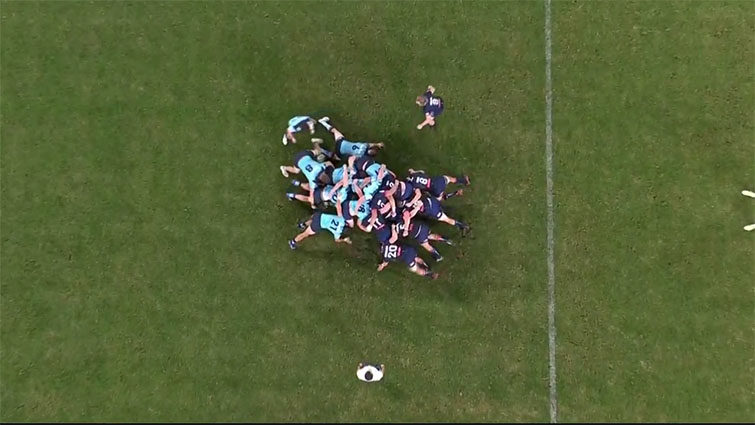
There is no attempt to walk around the loosehead side in this example from the first half of the match against the Force. There is some shift from right to left but the scrum goes forward equally on both sides. At the referee’s eye level – without the spider-cam privileges enjoyed by a TV audience – it an easy call for the man in the middle.
The formation of the scrum is asymmetrical, not symmetrical. There is an open and a closed side. The player on the closed or tighthead side must contend with the pressure from two angles, exerted by the opposing hooker and loosehead prop. If he does nothing but scrum straight and square, he is a sitting duck to be popped out.
A good tighthead prop will fight back by changing his angle and body height to increase the discomfort for his opposite number:
In this, the first scrum from the grand final, Brumbies loosehead Scott Sio is struggling to contain Taniela Tupou’s power. Tupou is able to drive past Sio and onto hooker Lachlan Lonergan, which leaves the ACT man facing in at a 90-degree angle to the far sideline, and eventually collapsing in the tunnel.
Paenga-Amosa and Fotuaika are pushing straight, and the scrum is moving forward on both sides:
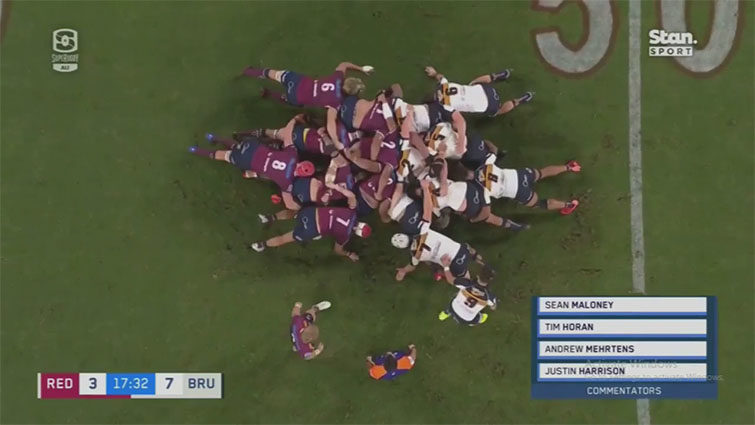
The alarm bells start ringing in the referee’s head when the scrum advances on only one side and begins to spin on its axis:
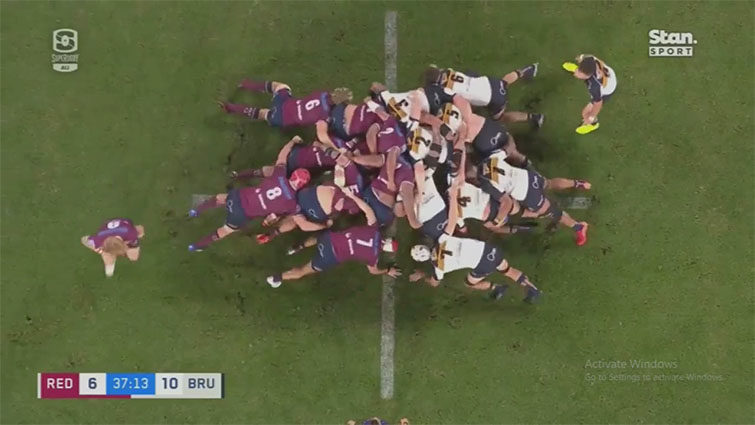
There is no major difference in the angle taken by Taniela Tupou, who is still dominating his side of the front row. The difference is that Fotuaika is meeting sterner resistance from Allan Alaalatoa, and therefore the scrum begins to turn around the Queensland tighthead. That persuades Nic Berry to award a penalty against Tupou.
On at least one other occasion, he rewarded him in a very similar scenario:
Tupou’s angle is probably even steeper, but nonetheless it is clear that it is the Brumbies scrum which is fragmenting under pressure.
The tighthead prop is fully entitled to scrum in the gap between the two opponents facing him and change his angle when he smells weakness. When Ethan de Groot and Tupou come off the bench tonight, it is up to the Highlanders prop to do a better job than Scott Sio and Harry Lloyd could manage last Saturday.
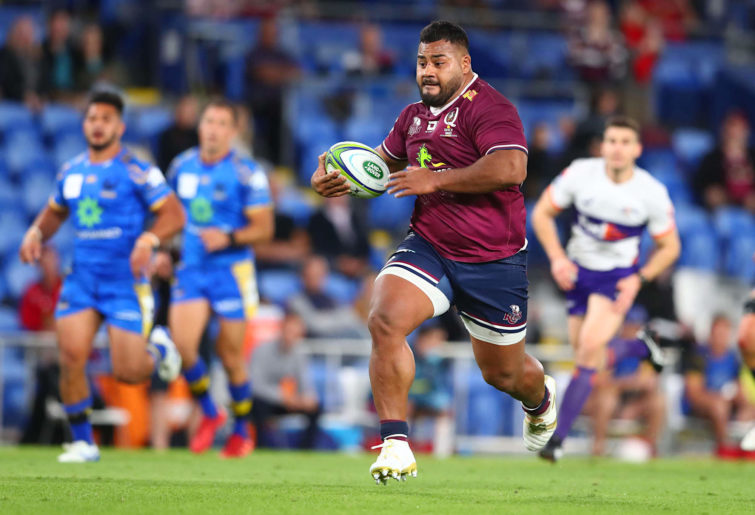
Taniela Tupou. (Photo by Chris Hyde/Getty Images)
It would appear that the level of analyst information available to Australian players at top levels is deficient in comparison to that which players receive when playing for the likes of the Crusaders, La Rochelle, and Leinster. How far behind are Australian teams in this area? Are the Brumbies ahead of the pack, despite their knife-edge losses to the Reds this season?
– Mzilikazi
Four of the coaching staff for the Boks during the World Cup honed their skills in Pro 14 at Munster. Rassie Erasmus, Jacques Nienaber, Felix Jones and Aled Walters. That has just reinforced the perception that rugby’s intellectual heartland now lies firmly in European territory.– Just Nuisance
The gap is closing, and that is a function of the structure of the domestic competition now in place. Increased depth in the preparatory work is possible when the number of opponents is drastically reduced.
In the last full season of Super Rugby back in 2019, there were 16 rounds against 15 potential opponents from all over the world, with games played week-in, week-out, and considerable travel and recovery time eating into the portion set aside for preparation. In Super Rugby AU, there are four opponents and the travel is local. Most of the individual strengths and weaknesses will already be well known to the coaching staffs and players.
There were plenty of examples of great prep work during Super Rugby AU, which I have attempted to track throughout the season. Having said that, I would go along with Scott Fardy’s statement that players’ capacity to absorb information is probably still greater in the northern hemisphere.
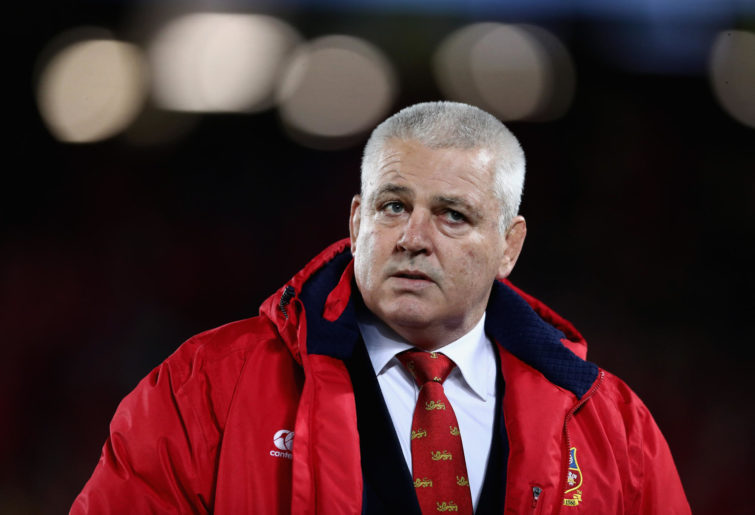
British and Irish Lions coach Warren Gatland. (Photo by David Rogers/Getty Images)
The Lions’ coaching team apparently used their 37th selection to pick Saints’ Courtney Lawes, who is actually the most legitimate bruiser in the second row now; and the 36th pick may have been Elliot Daly, selected first as an outside centre. What can we tell from this? Did the Alun Wyn Jones-Maro Itoje-Iain Henderson-Johnny Hill stocks look a bit light or small or tame? Who starts at 13: Daly or Chris Harris?
– Harry Jones
It’s Lions watch time! The selection indicates that the Lions will look at either Courtney Lawes or Tadhg Beirne for number six in the Test series, with Maro Itoje and Alun-Wyn ahead of them in the second row.
There is no chance of Elliot Daly starting a Test at outside centre in South Africa. At least two England players who weren’t taken on tour (Henry Slade and Jonathan Joseph) are far better defenders in that spot – not to mention Jonathan Davies and Garry Ringrose.
Outside centre in particular, and the midfield from 9 to 13 in general, is much the weakest area of the selected Lions squad. I do not see Chris Harris as a 13 in the same class as those I’ve mentioned (or Manu Tuilagi, for that matter), and I believe the Lions will end up moving Robbie Henshaw there, with Bundee Aki at 12 and either Owen Farrell or Dan Biggar at flyhalf in the Tests.
Once again, many thanks to all of those who answered the callout for questions.
Original source: https://www.theroar.com.au/2021/05/14/coachs-corner-issue-12-can-taniela-tupou-keep-it-straight-for-super-rugby-trans-tasman/
Wednesday, 12 May 2021
Anti Barking Vibration Control Device for Small Medium Large Dogs – No Shock
FAST OUTCOMES: Are you searching for a secure as well as efficient service to quit your canine barking? Utilizing our anti bark control collar you need to see outcomes QUICK. Our faithful clients are surprised just how swiftly it has actually aided them. The anti barking tool produces a TRANQUILITY, SILENT area. It will certainly NOT HURT your family pet in all. It utilizes resonance as well as audio (unlike ultrasonic or citronella) for optimal impact.

SMART NO BARK INNOVATION: New Improved for 2019, Our barking collars make use of a smart caution system that offers a high level of improvement and also control as well as instructs your pet to discover to quit barking promptly. Train your pet dog without a muzzle or a whistle. A real antibark deterrent that can find and also overlook barking from various other pets. Obedience guaranteed. Not a shock collar for pets. Look into todays bargains/ free gifts
FITS ALL TYPES: Tiny, Tool or Huge pet dog? Interior or Outside? Persistent type? Labrador Retriever German Guard Bulldog Beagle Terrier Poodle or Chihuahua? Not a problem! Matches virtually any kind of dimension pet dog. EASY to readjust - 9 inches to 22 inches (25-55cm). Fashionable and also reflective. Resilient products. Your pet dog will rarely see it. 2 colours - ORANGE & BLUE paws can be found in package.
SIMPLE ESTABLISH: Obtain your pet dog training collar up as well as running in much less than 5 mins with our BASIC guidelines. (Battery Consisted Of). Includes our very own E-BOOK with 8 FANTASTIC SUGGESTIONS for taking care of your pet dog!

ACQUISITION WARRANTY: My Pet Issue are a REAL household company that replies to EVERY testimonial. Our bark collars are backed by our 100% assurance. My Pet dog Predicament concentrates on HONESTY, EXPERTISE as well as WONDERFUL CUSTOMER SUPPORT:--RRB-.
FAST OUTCOMES: Are you looking for a risk-free and also efficient remedy to quit your pet dog barking? Utilizing our anti bark control collar you ought to see outcomes QUICKLY. CREATIVE NO BARK MODERN TECHNOLOGY: New Improved for 2019, Our barking collars utilize a smart caution system that gives a high level of improvement as well as control as well as instructs your canine to discover to quit barking promptly. A real antibark deterrent that can find and also overlook barking from various other pets. Our bark collars are backed by our 100% warranty.
We Are pleased to bring you the Everyday Urban Bark collar.
MAINTAIN THE TRANQUILITY!
Allow's encounter it, despite just how wonderful our pet dogs are, extreme barking throughout the day or evening can be demanding. This impacts you, your family members as well as frequently your neighbors.
BASIC YET EFFECTIVE
The collar will certainly begin educating your pet dog as quickly as you place it on.
The dynamic resonances and also noises are created to supply a collection of cautions that will swiftly show the ideal behaviors.
You do not require to maintain it on regularly, simply when required.
Our collar is human as well as secure. No discomfort whatsoever, Simply mild pointers.

THE TECHNOLOGICAL THINGS
There are 7 cautioning cycles that considerably obtain much longer, varying from a caution beep to a caution beep+ resonance.
IN PACKAGE
1 x top quality Everyday Urban collar with reflective strips.
Blue as well as Orange encounter plates
2 x Long Life Batteries
2 x collections of secure prongs
1 x English user's manual
My Pet Issue E-book (through guarantee enrollment
CRUCIAL: Although the majority of our consumers state that our bark collar is 100% effective by itself and also works with a lot of canines, some persistent canines might need added corresponding training to accomplish success.
Tuesday, 11 May 2021
It’s official: Waratahs chairman Roger Davis heads for the exit
Long-serving NSW Rugby Union chairman Roger Davis will step down from his position at the end of the month, opting not to stand for re-election at the upcoming AGM.
Davis, who joined the board 12 years ago and has been chairman since 2012, has been the subject of much criticism recently. While he oversaw the Waratahs’ Super Rugby title in 2014, he has also been at the helm during the side’s slide down the standings in recent years, culminating in a winless Super Rugby AU campaign this season.
The decision to sack coach Rob Penney at the end of March also drew significant fan anger, and it was widely speculated at the time that Davis would stand down at this month’s AGM.
The NSWRU board has selected Tony Crawford to take over as chairman, and he will be formally elected at the May 31 meeting.
“It is an honour to be elected as Chairman at a time when we are going through so many changes at the Waratahs and I see improving the alignment of rugby in NSW, from the grassroots to the professional level as one of our highest priorities,” Crawford said.
Crawford has been a NSWRU director since 2018, and previously had a seven-year stint as a director at Northern Suburbs.
Outgoing chairman Davis said it was the right time for a new chairman.
“A new CEO is in place, the search is underway for a new head coach, we have a young and talented team showing all the signs of a great future ahead of them and our centre of excellence is about to begin construction,” Davis said.
“As Chairman I’ve been able to oversee all of this and other major milestones at NSW Rugby, including the Waratahs making two semi-finals and winning the Super Rugby Championship in 2014, negotiating the merger of the NSW and Waratah boards and securing the financial future of the organisation.
“While rugby has faced some serious headwinds over the last few years, I think at club and state level, NSW is at the beginning of a new and sustained period of success.”
Original source: https://www.theroar.com.au/2021/05/10/its-official-waratahs-chairman-roger-davis-heads-for-the-exit/
https://therugbystore.com.au/its-official-waratahs-chairman-roger-davis-heads-for-the-exit/
Monday, 10 May 2021
Premiership: Harlequins 48-46 Wasps - Marcus Smith stars for Quins in epic
Marcus Smith inspires Harlequins to a thrilling 48-46 win over Wasps, after Mike Brown's red card left them with 14 men.
Original source: http://www.bbc.co.uk/sport/rugby-union/56996921
Saturday, 1 May 2021
Women's Six Nations: England's Poppy Cleall wins Player of the Championship award
Forward Poppy Cleall wins the Player of the Championship award after playing a key role in England's Women's Six Nations title defence
Original source: http://www.bbc.co.uk/sport/rugby-union/56933494
Coach’s Corner Issue 10: How loose can you be?
Thanks once again to all who either contributed a question, or debated one in this week’s callout. Watching a query as it is refined through discussion can be especially helpful to my responses on Friday.
Is it just me or does it appear that our most consistent forwards in terms of total contribution are weighted to Force, Rebels and Brumbies? Waratahs and Reds both seem a bit short of impact?
– Noodles
Statistically, who are the most effective loose forwards in Super Rugby AU and Super Rugby Aotearoa?
– KiwiHaydn
What do you think of the role of playing flankers or number eight in the second row? Last week Rob Leota, Angus Scott-Young and Hugh Sinclair were all in the second row. These players are generally around 190cms. Do you see this working in international rugby?
– Take the Points
These questions are all related to one another, directly or indirectly. As the game gets faster and the ball-in-play time increases, one of the spots coaches tend to look at for an increase in overall team speed is the second row. There has been something of a boom in players who can operate equally effectively in the last two rows of the scrum.
Some of the best big men in the UK and Ireland can handle both number six and second row efficiently – Maro Itoje and Courtney Lawes in England, Tadhg Beirne and Iain Henderson in Ireland, Bernard le Roux in France. Even Alun-Wyn Jones started out as a blindside flanker before deciding his best position was going to be one row ahead in the pros.
If all five of those players were fully fit, they would be on the plane to South Africa with the Lions in a couple of months. There, they will lock horns with the best of breed on the planet in the shape of Pieter-Steph du Toit. In order for these players to succeed at Test level, as a general rule they have to be 195 centimetres plus.
The meat of the question is a comparison of the productivity of the loose forwards in Super Rugby. I’ll leave Super Rugby Aotearoa to a separate column and focus instead on AU.
Here is a table containing the stats for the top loose forwards in Australia. I’ve used 450 minutes of play as the baseline for inclusion. There are also two forwards – Tim Anstee and Lachie Swinton – who have not racked up the minutes, but are clearly players of national interest.
First, the attacking stats.
| Minutes between carries | + or – impacts | Decisive outcomes (breaks or try assists) | Lineouts won | |
|---|---|---|---|---|
| Harry Wilson | 7.1 | +3 | 0 | 5 |
| Pete Samu | 14.7 | +3 | 8 | 9* |
| Brynard Stander | 8.3 | +8 | 1 | 4 |
| Michael Wells | 14.2 | +9 | 4 | 17 |
| Angus Scott-Young | 11.5 | +3 | 0 | 17 |
| Rob Valetini | 10.3 | +11 | 4 | 2 |
| Tim Anstee | 8.2 | +2 | 5 | 16 |
| Lachie Swinton | 8.6 | +5 | 0 | 14 |
| Josh Kemeny | 10.5 | +8 | 1 | 5 |
| Fraser McReight | 9.8 | +14 | 10 | 1 |
| Kane Koteka | 12.1 | +12 | 3 | 1 |
| Richard Hardwick | 14.5 | +3 | 3 | 0 |
| Carlo Tizzano | 9.2 | +7 | 2 | 0 |
*includes steal
‘Minutes between carries’ is a guide to work-rate on attack, while the ‘Impacts’ (gain-line wins) and ‘Decisive outcomes’ columns are measures of success. Lineout is obviously another key stat for the bigger men at numbers six and eight.
Harry Wilson has a huge work rate (more than twice the frequency of carries compared to Pete Samu, for example), but he has really struggled to make an impact in 2021.
Wilson and Samu offer two contrasting interpretations of the number eight’s role: Wilson an inside power runner and ground-gainer, Samu operating in the wide channels as a strike runner and game-breaker.
Rob Valetini is by far the most dominant number six on the gain-line, while Tim Anstee holds out the promise of being able to fill the Samu-type role at lineout and wider out in attack.
Fraser McReight is obviously the outstanding number seven playing in Australia, and the relative lack of success of Wilson and Angus Scott-Young on the gain-line at the Reds has not inhibited his orbit of influence as an attacker.
Here are the stats for defence.
| Mins between tackles | Tackle completion | Discipline/turnovers (inc. pens conceded) | |
|---|---|---|---|
| Harry Wilson | 7.2 | 88% | -9 |
| Pete Samu | 9.3 | 87% | -6 |
| Brynard Stander | 7.2 | 81% | -2 |
| Michael Wells | 9.6 | 92% | -10 |
| Angus Scott-Young | 6.9 | 91% | -9 |
| Rob Valetini | 7.8 | 92% | -3 |
| Tim Anstee | 6.3 | 89% | -3 |
| Lachie Swinton | 4.9 | 88% | -8 |
| Josh Kemeny | 6.9 | 96% | -5 |
| Fraser McReight | 6.6 | 94% | -2 |
| Kane Koteka | 5.6 | 86% | -9 |
| Richard Hardwick | 8.4 | 83% | 0 |
| Carlo Tizzano | 4.1 | 90% | -7 |
‘Minutes between tackles’ is used to represent work rate on defence, while the ‘Discipline/turnovers’ column weighs turnovers won against those given up and the penalties conceded by the same player. A figure close to zero is an excellent outcome.
The immense tackle work rates for both Swinton and Carlo Tizzano (both sub-five-minute tackle intervals) illustrate how little possession the Waratahs were able to win and maintain this season. Swinton’s discipline and his defence of the ball on the carry remains a concern, as his minus-eight was derived from only 350 minutes of play.
McReight’s numbers are just as outstanding on defence as they are in attack. He made 11 turnovers while only giving up six penalties at the defensive breakdown, and maintaining a tackle percentage in the mid-90s.
The number of involvements by Harry Wilson is again very impressive, but there is the same lack of impact or quality. There is a sense Wilson is undergoing a plateau in his pro career, and urgently needs the support of another number eight of a similar type – like Isi Naisarani – in the Wallabies.
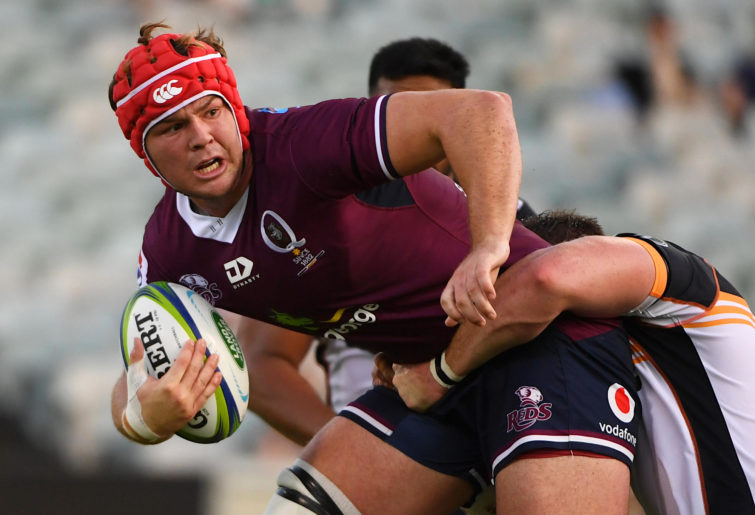
Harry Wilson. (Photo by Tracey Nearmy/Getty Images)
Watching the Waratahs’ centre pairing over the past few weeks has been at least one bright spot for the team. How do we unlock their potential better? Do you see any Wallabies game time for Izaia Perese or Lalakai Foketi?
– Stin
After a false start, Izaia Perese has arguably been the Tahs’ best attacker and he appears strong on defence, but is his defensive positioning good enough to make him a Wallabies contender?
– Hazel Nutt
Will Izaia Perese be the only backline representative from New South Wales in Dave Rennie’s match-day squad? I’m thinking Perese may get some time, he breaks nearly every tackle one on one and can also play on the wing.
– Take the Points
There does seem to be a difference in the quality of Perese’s involvements on attack and in defence. He can be a lethal offloader in the wide channels:
Two different types of offload executed perfectly – right-arm underhand to Mark Nawaqanitawase in the first example, out of the back of the hand to Jack Maddocks in the second. Perese ensures that the last defender is committed before delivering the pass.
So far, so good.
Things did not look as proficient on defence against the Force, however.
In the first example, the Waratahs have the numbers out wide, but Perese loses Tevita Kuridrani to a simple cut off his right foot – he has to remain connected to the forward inside and protect him. Later in the same sequence, his side of the defence was again beaten on equal numbers.
Perese’s tendency to sit off and let play develop in front of him creates a lot of difficulties for the men around him:
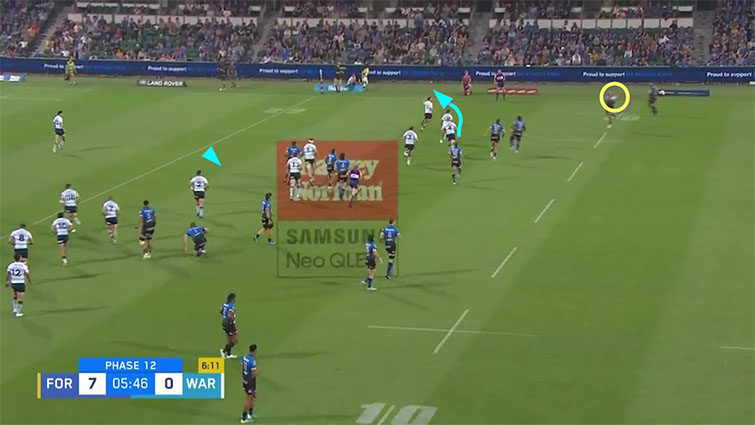
That means a lot of work for the defence coach Matt Taylor if Perese gets the call to Camp Wallabies.
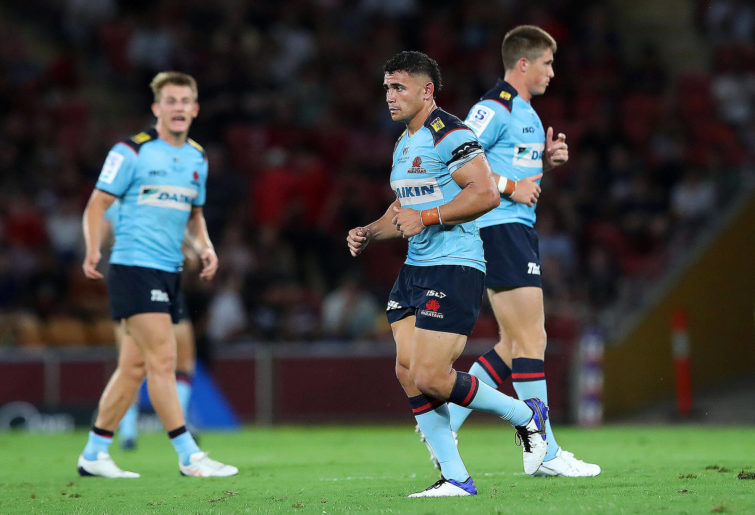
Izaia Perese. (Photo by Jono Searle/Getty Images)
Some tighthead props bind low on the hooker’s shorts instead of up across the shoulder. Physics of this bind angles his body inwards and thereby concentrating the drive energy towards the hooker. Why do they do this? Is it to concentrate more energy on the hooker and force the scrum inwards or, is it a counter move to stop the hooker coming through that space?
– Wayne
If you watch the front rows set up for a scrum, you’ll notice the loosehead and hooker binding up tight first, in the region between chest and shoulders. The better tightheads will enter as the last man and look to bind as low on their hooker’s shorts as possible with their left arm.
Why? Because it gives them maximum flexibility in the shoulders to change their angle of attack in the gap. The tighthead is scrumming against two opponents (the opposition hooker and loosehead), so he needs the flexibility to be able to counter that pressure on his own terms.
The low bind allows Cabous Eloff to drop inside and follow Jordan Uelese through the middle of the Waratahs scrum to win a game-clinching penalty. Eloff is, incidentally, a prop well worth a look from the Wallabies coaches as a support tighthead in 2021.
Who should be the halves pairing for the Lions?
– Tim Westphal
With most head contact in a tackle now leading to a sending-off, is it worth going for a dominant chest tackle when the slightest miscalculation or accident can see these shots hitting the ball carrier high?
– tighthead
May I throw Owen Farrell’s name into the mix?
– Just Nuisance
Folks, it’s Lions watch time again! Warren Gatland has always tended to prefer a solid tactical navigator and a big defensive number ten in his teams, so my guess that the likes of Owen Farrell, Dan Biggar and even Johnny Sexton will be preferred to Finn Russell and George Ford.
One of the reasons you need a strong high tackler there is South Africa will pick a giant inside centre to run straight down that channel – a Damian de Allende (1.91m and 105 kilos) or an André Esterhuizen (even bigger at 1.94m and 115 kilos).
If you cannot stop de Allende and Esterhuizen or prevent them from passing through contact, it is unlikely you will be able to stop the Bokke power game. This presents some problems with the current refereeing sensitivity to shots at shoulder height.
Remember what happened the last time ‘Faz’ and Esterhuizen clashed in an England versus South Africa game?
At the time (November 2018), this tackle did not even incur a penalty. In the current climate, it would definitely be worthy of a card – the only question would be the colour. Warren Gatland is sitting on the horns of a dilemma.
Thanks to all of those who contributed once again, unanswered questions will be stored for future issues.
Original source: https://www.theroar.com.au/2021/04/30/coachs-corner-issue-10-how-loose-can-you-be/
https://therugbystore.com.au/coachs-corner-issue-10-how-loose-can-you-be/
Subscribe to:
Posts (Atom)